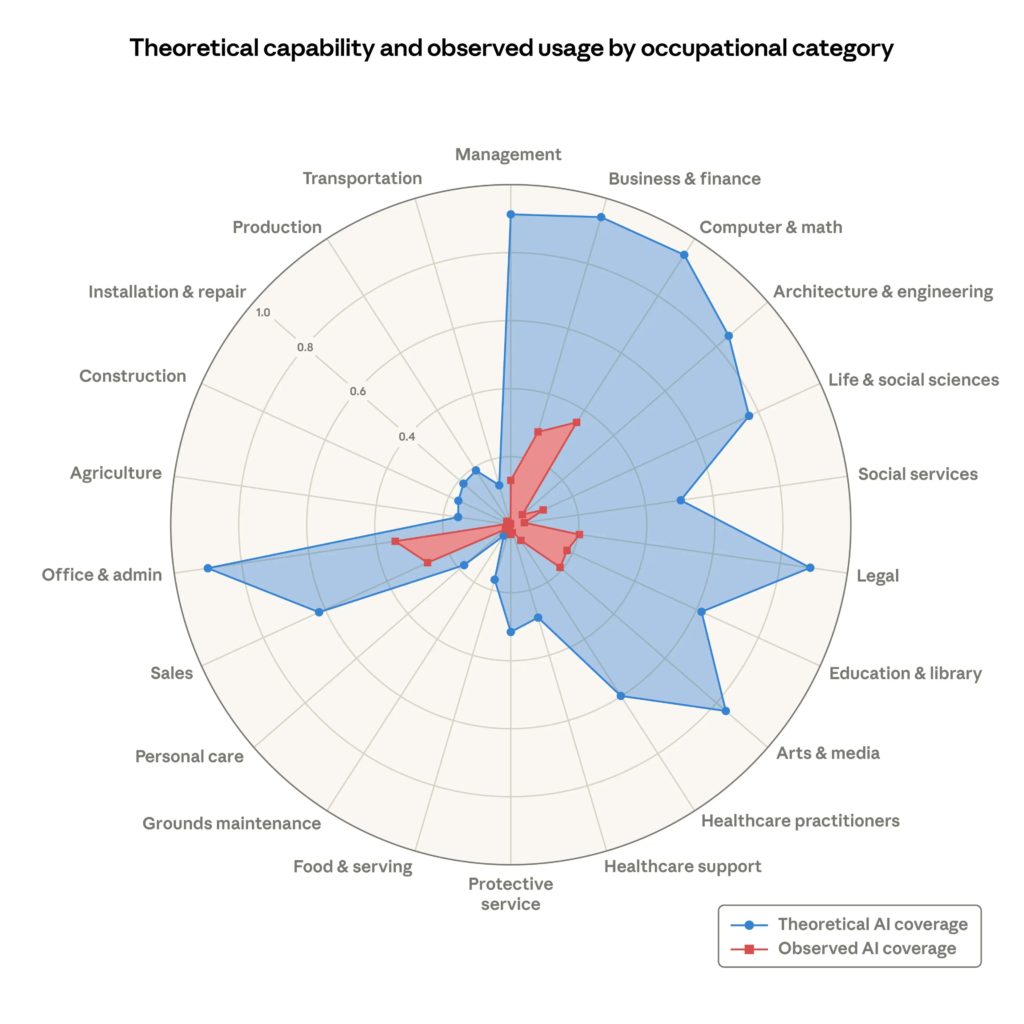
In a recent publication, the CEO of Anthropic highlighted a key paradox: the widening gap between the theoretical capabilities of AI and it actually being adopted within organisations. Today, AI is capable of automating or enhancing a significant share of knowledge-based work across areas such as finance, management, legal services and technology. Yet despite these advances, practical implementation remains relatively limited, creating a transitional period in which the impact on employment is only just beginning to emerge.
This phenomenon is unfolding against a backdrop of growing workforce reductions being announced by large corporations, particularly in the United States and Europe. The sectors most exposed to AI-driven productivity gains – consulting, investment banking and technology – are also among the first to experience reductions in the workforce. At the same time, recent graduates are facing growing difficulties entering the job market, and this includes fields that were once regarded as secure career paths. Yet the public debate remains primarily focused on large companies, overlooking a group of equally important players: small and medium-sized enterprises (SMEs). In most economies, SMEs account for between 60 and 70 per cent of employment and value creation. Far from being passive observers of this transformation, they may ultimately prove to be its greatest beneficiaries.
Unlike large organisations, SMEs tend to adopt AI gradually and in a highly targeted way, applying it in areas such as administrative processes, data analysis and customer relations. This approach, often driven by resource constraints, gives them a degree of strategic agility that larger organisations frequently struggle to match.
Experienced professionals and recent graduates facing intense competition within large organisations may increasingly turn to these businesses, which have historically been disadvantaged by lower salaries, reduced visibility and perceived limitations in career prospects, but are now becoming more agile and attractive.
Indeed, many of the traditional strengths of SMEs are perfectly aligned with the skills most valued in the age of AI: adaptability, versatility, the ability to learn quickly, and a direct contribution to business performance.
This shift could even reverse traditional career pathways. The “large company first” model is becoming less relevant. SMEs are increasingly emerging as environments that offer accelerated learning opportunities and early exposure to strategic decision-making.
Ultimately, AI is not simply a story of human replacement or job displacement; it is also reshaping the distribution of opportunity. While large organisations remain at the forefront of AI development and deployment, SMEs are particularly well positioned to benefit from its secondary effects, especially in terms of talent acquisition and value creation. The organisations and individuals that can anticipate and adapt to these shifts will be best placed to capitalise on the next phase of transformation in the labour market.